
What is the cost versus value of digitizing validation? The answer is rarely the same between stakeholders and a business case framed around a single metric fails to address a multifaceted value discussion.
Finance hears investment versus payback. IT hears upfront labor versus downstream security. Quality hears process reinvention versus improved inspection readiness. Operations hears retraining staff versus speed to delivery.
ISPE's guidance on digital validation points to a logical structure: analyze how the change lands with each stakeholder group, then make the case in the terms that group cares about. This post takes that approach. The numbers are general on purpose; any real calculation is predicated on your systems, your team, and your current process.
Start with a baseline
Before modeling, measure the baseline. Typical validation time from kickoff to release, number of review cycles a document goes through, how often documents come back for correction, the hours required for assembling audit packages, and how long it takes to retrieve a specific record.
Finance: payback and a fair ledger
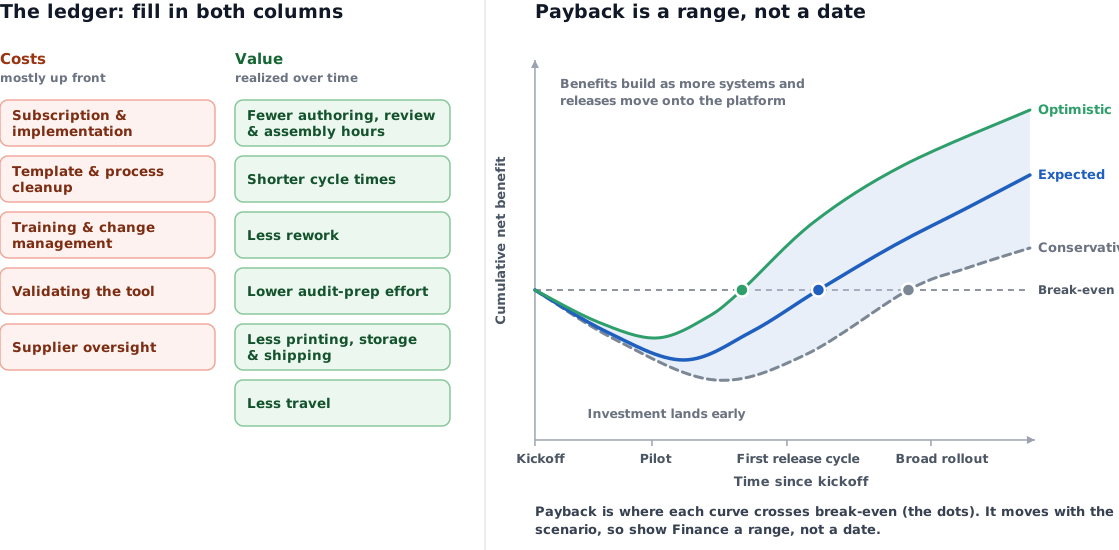
Finance wants to know time to value. Build a business case with a benefits versus cost ledger.
Benefits are the familiar column:
- Fewer labor hours spent authoring, reviewing, and assembling — and far less rework
- Shorter cycle times
- Lower audit-preparation effort
- Less printing, storage, and shipping
As a starting point, reports commonly put reductions in cycle time or labor hours at around half, with wide variation by scope and starting point.
Costs are equally important:
- Recurring subscription and one-time implementation costs
- Cleaning up templates and processes to scale better
- Training and change management
- Validating the tool itself
- Supplier management
If templates and workflows are inconsistent and cumbersome today, simply translating them to digital retains the same root issues. Optimizing them requires upfront lift and downstream change management. The payback, of course, is speed and scale without compromising data integrity.
Time-to-value matters too. A faster go-live brings the payback date forward, which is why implementation effort belongs in the ledger alongside license cost.
Build conservative, expected, and optimistic scenarios. Vendor-reported payback periods tend to land within the first year or two, not the first few weeks. A range illustrates this.
IT: integration, security, and scale
IT asks architectural questions: how the platform integrates with current systems, data security, ease of scalability as the validation portfolio grows, and the hard costs of running it.
A SaaS platform shifts much of the burden to the vendor, including the infrastructure costs. Expect supplier assessment and audit, a defined process for evaluating each vendor release against validated functionality, and a plan for retention and exit if the relationship ends. Integration with QMS, ERP, and MES systems, plus single sign-on and role-based access to fit existing identity controls, belong in the ledger too. (VLMcare’s security and compliance posture is published on its Trust Center.)
Do not skip interrogating the costs of future expansion. Determine if there are license costs and rollout burden for adding another system, site, or validation type. With some vendors, that means buying a module, upgrading your license tier, or engaging with the vendor’s professional services. A platform like VLMcare that handles CSV, CSA, qualification, and cleaning validation in one application simplifies that answer.
Quality: risk reduction and audit readiness
Quality seeks risk reduction and audit readiness. One clear measure of value seems obvious on the surface: don’t get a 483 or warning letter.
But tread cautiously with enforcement statistics. The share of warning letters that involve documentation and data integrity is always more than zero no matter how narrowly the category is defined and which letters are counted.
Flaws in documentation and data integrity are recurring themes, but for quality teams, day-to-day value is more compelling. Quantify hours spent assembling audit evidence, rebuilding traceability matrices, and assessing risk consistently across systems. This is not just for the sake of audits and inspections, but for record reliability and control of the systems quality.
Digital systems like VLMcare help. It calculates risk priority consistently so teams can size testing to risk, captures evidence at the moment of execution, and ensures records are attributable, contemporaneous, and traceable by design (the ALCOA++ expectations).
Operations: speed, consistency, and capacity
Operations cares about lifecycle speed and product consistency. Validation workloads are rising. Headcount is not. For many teams, the value is not cost removed but capacity gained: handling more systems, releases, and changes.
Within VLMcare, several mechanisms of its object-based design enable new levels of velocity. Parallel authoring. Reuse of requirements, test cases, and risk assessments. Consistent, risk-based scoring.
For contract manufacturers and CDMOs, analysts have also pointed to a revenue-side effect: lower delivery costs, capacity to take on larger programs, and stronger client retention.
Sustainability: a proven and defensible story
A defensible sustainability story requires quantifiable inputs: pages printed, off-site storage, shipping volume, and travel burden. It’s easy to calculate your footprint.
Digital records have their own footprint. Storing and managing data consumes energy; AI usage is particularly energy-intensive. However, the net reduction in physical records and their associated costs has a very measurable benefit, enough for an ESG review.
Putting it together
A simple scorecard organizes the conversation. For each measure, record the baseline, set the target as a relative change rather than an absolute number, assign an owner, and pick measurement points.
| Stakeholder | What to measure | Where the benefit shows up |
|---|---|---|
| Finance | Total cost of ownership against baseline; time to payback | Scenario range, reviewed after a pilot |
| IT | Infrastructure and support effort; integration and release-assessment effort | Lower qualification burden, added supplier oversight |
| Quality | Audit-prep hours; record retrieval time; documents returned for correction | Inspection readiness |
| Operations | Cycle time; review rounds; work absorbed per team | Capacity and speed |
| Sustainability | Pages printed; storage and shipping; travel | Documented footprint reduction |
Why the ceiling differs
Not every digital validation approach produces the same value.
For example, simply “going paperless” by moving documents onto screens is a one-dimensional gain: less printing, faster routing.
The returns compound when every system and release are transformed from “paper-on-glass” documents to structured data that intelligently links modular requirements, risks, and test cases instead of leaving them as plain-text paragraphs inside documents. The traceability matrix becomes an always-current asset.
The design principles behind VLMcare introduce a new way to structure and execute validation lifecycles. Because of that, VLMcare requires a new means to define the value of a validation lifecycle management system.
Vendors — us included — will often trumpet large, compelling percentage statistics like “50% reduction in validation effort”. That stat is defensible. Our own customers have verified it. But it’s just one part of a holistic approach to defining value.
The strongest business case survives scrutiny from every seat at the table. Start from a baseline, show the costs, use ranges, and empower each stakeholder to find the value that is maximally compelling.